Our vision
Everyone should have sufficient, reliable access to affordable, nutritious food.
There are no easy answers to solving hunger. The causes are as diverse as the people it affects.
The vulnerable communities AzFBN serves are unique. Each requires an innovative approach. AzFBN has the capacity and team to develop and implement community-driven solutions for sustainable outcomes.
Below are some of the populations AzFBN works to find solutions for hunger with.
learn more
Children
We work with schools, government agencies, and local community partners to ensure every child gets the food and nutrition they need. This helps avoid all kinds of host of negative health impacts for children that can affect them for a lifetime! It also sets them up to fail academically. Who can learn when they’re hungry and – why would we expect children to?
The goal is simple: ensure every child in Arizona gets 3 nutritious meals a day, 7 days a week, no matter if school is in session or children are on break. Sounds simple enough, right? Unfortunately, this is much more easily said than done. Visit our childhood hunger page to learn more about the programs and resources we use to make this happen.
learn more
Native Americans
One in four Indigenous Arizonans experience hunger—more than double the state average. AzFBN partners with five locally led committees working to restore traditional foodways and advance food sovereignty. These committees conduct needs assessments and develop community-led solutions such as tribal gardens and intergenerational food knowledge sharing.
AzFBN helps convene partners and provides technical support to ensure these efforts reduce food insecurity while preserving culture. Check out our blogs on Native Stories here.
learn more
Military Hunger
Veterans are 7.4% more likely to experience food insecurity than their non-Veteran peers, with even higher rates in rural areas. In 2020, up to 24% of active-duty service members and their families faced food insecurity, yet only 5.8% of Arizona Veterans were receiving SNAP in 2019. In response, AzFBN launched the Arizona Veterans Anti-Hunger Task Force, a coalition of 15 organizations working to connect Veterans and their families to food assistance and benefits. AzFBN serves as a connector between food banks, pantries, Veterans’ groups, and government agencies to identify gaps and strengthen support systems. Interested in joining the Task Force? Email: isabel.hoggatt@azfoodbanks.org
learn more
LGBTQIA2S+
Food insecurity affects 22% of LGBTQIA2S+ individuals nationally, and they apply for SNAP at twice the rate of non-LGBTQIA2S+ individuals. Despite these disparities, little data exists about LGBTQIA2S+ hunger in Arizona.
AzFBN is working to fill this gap by conducting surveys and focus groups with LGBTQIA2S+ youth, adults, and elders. Once data collection is complete, AzFBN will publish findings and launch a coalition to identify next steps in supporting this community through inclusive and affirming hunger relief strategies. Read a blog about LGBTQ hunger here
learn more
Older Adults
10,000 Arizonans turn 65 every day. By 2030, 20% of Arizona’s population will be people over 65. So it’s no surprise that older adults are the fastest growing food insecure population in the nation. Sadly, many fixed-income seniors don’t have the income necessary to pay for their medical bills and food, forcing a tragic decision between the two. We work with senior centers, government agencies, and local nonprofits to ensure older adults get the food and nutrition they need.
learn more
Migrant Farm Workers
Migrant farm workers—vital to Arizona’s agricultural economy—face food insecurity rates between 47% and 82%, far higher than the national average. Low wages, lack of SNAP eligibility, and barriers like language, transportation, and legal status leave many families struggling. In partnership with St. Mary’s Food Bank Alliance and Tonatierra, AzFBN operates a mobile food distribution serving 200 farmworker families monthly. AzFBN also advocates for inclusive policies, provides culturally competent outreach, and promotes ethical consumer support to advance food justice for this essential workforce.
If you know of anyone who is working in these areas and would like to collaborate, please contact Meg Sneed at [email protected].
LEARN MORE
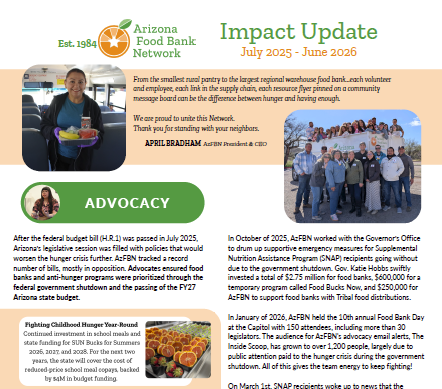
AzFBN 2026 Impact Update
The latest AzFBN Impact Update has been published. Read about all of the incredible progress we’ve made, with your help, in Fiscal Year 2025-26, from produce pounds to child nutrition, the government shutdown, and more!
 English
  Spanish