
“I found myself pleading with people to recognize food as a human right, and I wondered how we had become so lost and callous…”
What’s going on with SNAP In Arizona?
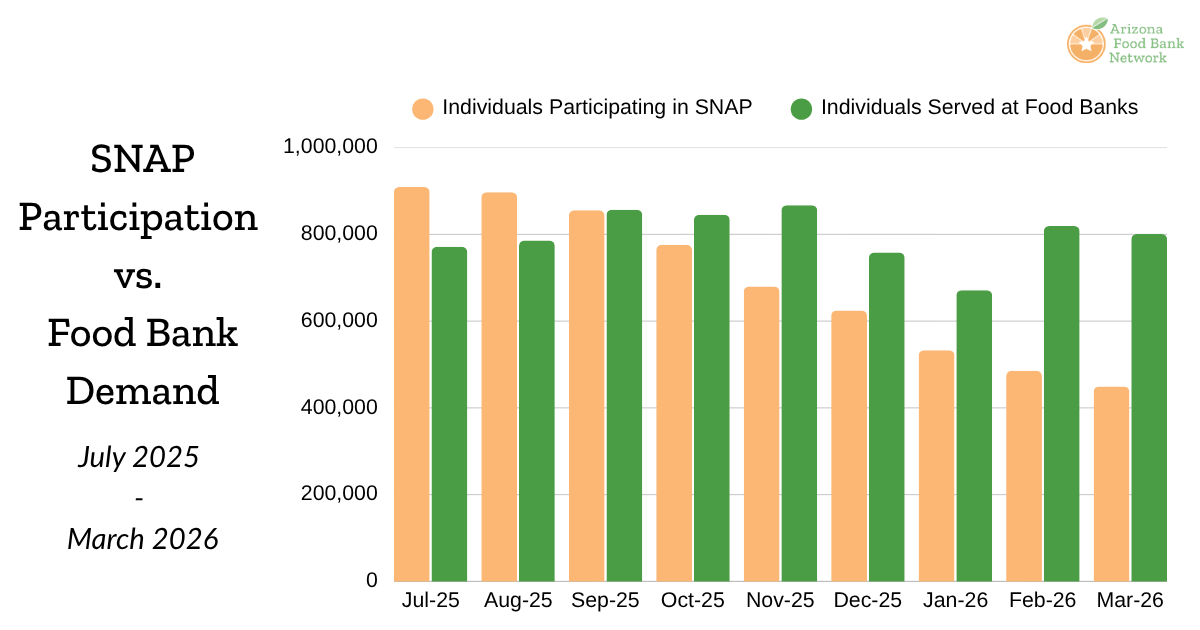
This is a question that we are getting pretty often these days, and for good reason: as of March 2026, the number of people participating in the Supplemental Nutrition Assistance Program (SNAP) has plummeted by 51%. And it’s no coincidence that food banks are seeing a surge in people needing their help (correlation does not equal causation, but it bears mentioning). Changes passed into law in the federal budget bill (formally known as H.R. 1 or the “One Big Beautiful Bill Act”) in July 2025 meant adjustments to eligibility for some, and changes for states that are running the program – big changes, without which SNAP could disappear for everyone.
And while food banks will do everything they can to help as many people as possible, when food banks have typically provided one meal for every five that SNAP and other federal programs do in Arizona, this is a big gap to fill.
We want to take a closer look at exactly what’s happening, and if people who should still qualify for SNAP are receiving that help.
Who better to follow up with than Presley?
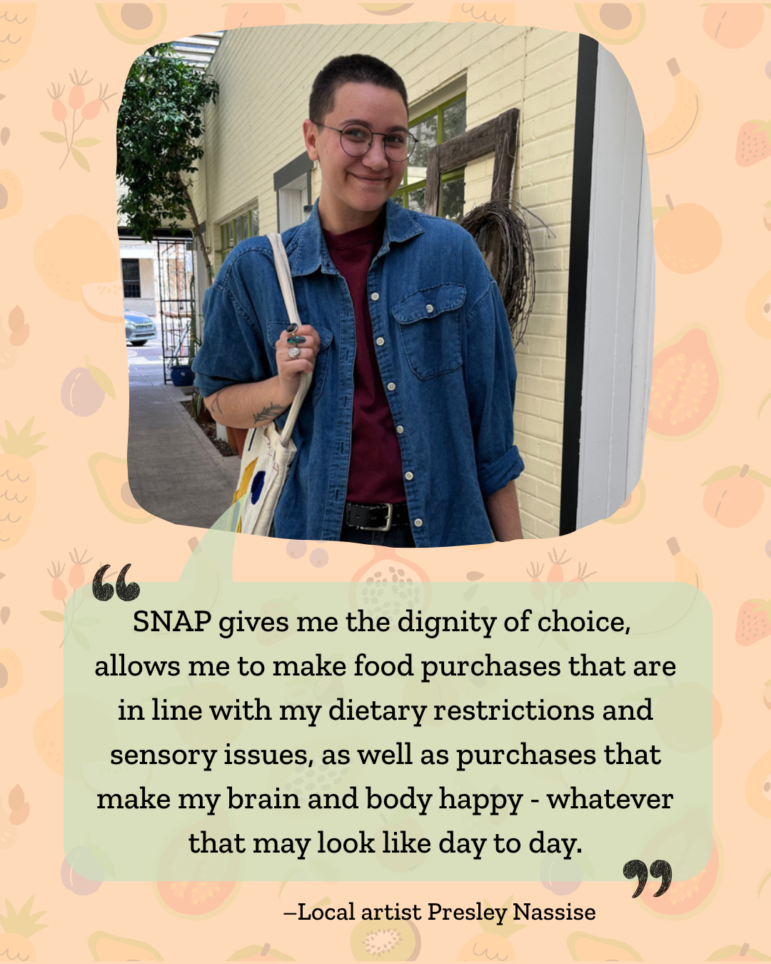
In June 2025, AzFBN published “The Dignity of Choice: A SNAP Conversation with Local Artist Presley Nassise.” Presley, who lives with chronic illness and works two jobs, kindly told his SNAP story. He was relieved by how quickly the grocery benefits transformed his physical and mental health, since he was able to make the best nutritional choices for his dietary restrictions.
We were surprised when, in March 2026, we caught up with Presley and learned that he was awaiting renewal of his SNAP benefits. It had been three months, and his renewal was pending. He tried to follow up, but couldn’t get on the phone with a case manager.
The SNAP renewal process, even with H.R. 1 changes, has typically been fluid, while at the same time ensuring the Department of Economic Security (DES) can monitor SNAP for fraud and abuse – to preserve benefits so that they reach the food insecure household that need them so badly. Having to renew SNAP is a standard process, but is also sometimes where people lose benefits. That extra admin is sometimes just too much for a family already struggling.
The AzFBN team is working with our partners at DES to ensure that changes that are necessary to react to H.R. 1 don’t come at the cost of preventing people who are hurting from getting help.
What can we all do better to make it easier to re-apply (and apply!) for SNAP?
Tell us your thoughts after reading about Presley’s journey:
AzFBN: Let’s start with the government shutdown in November 2025. How did you feel when it was announced that SNAP funds were frozen?
Presley: The first communication I received [about it] was a text message that was only a line or two. I felt incredibly disheartened, discouraged, and mostly emotionally exhausted.
It was almost unsurprising to me that we would be left without funds for November, when many families are celebrating and coming together for meals. I definitely had a few moments of hopelessness and fear…in short, the experience and ways in which DES communicated with SNAP recipients felt dehumanizing.
AzFBN: The timing of it was hard for so many people. Can you tell us about daily life, eating, and food planning throughout the uncertainty?
Presley: The uncertainty had a number of effects on my physical health and well-being. I was so stressed that my appetite was lower and I found myself skipping meals or saving portions for later, just in case. I lost weight and sleep…
I was very blessed to have many meals bought and made for me, to have a full belly throughout most of the month…but each day I worried about the families who had less support and access than I.
AzFBN: When you heard it might happen, did you try to prepare [for a disruption in benefits]? What did you do?
Presley: …I was fortunate enough to have about $50 left from my October funds, and went to the downtown farmers’ market to exchange that $50 for [$100 of] Double Up tokens, which do not expire.
Shamefully, I went through every bag and wallet I own searching for old gift cards and loyalty cards. I did find some and saved them away with my tokens, preparing for the end of the month when there would not be as much community support or news about the freeze. At the start of the month I had many friends reach out asking how they could support me and opening their doors to welcome me to their tables.
The queer community was in the forefront [for me]…one couple drove me to their home and cooked a hot meal that met all my difficult dietary restrictions…another couple even offered to add my grocery list onto theirs and purchase my groceries for one of the weeks.
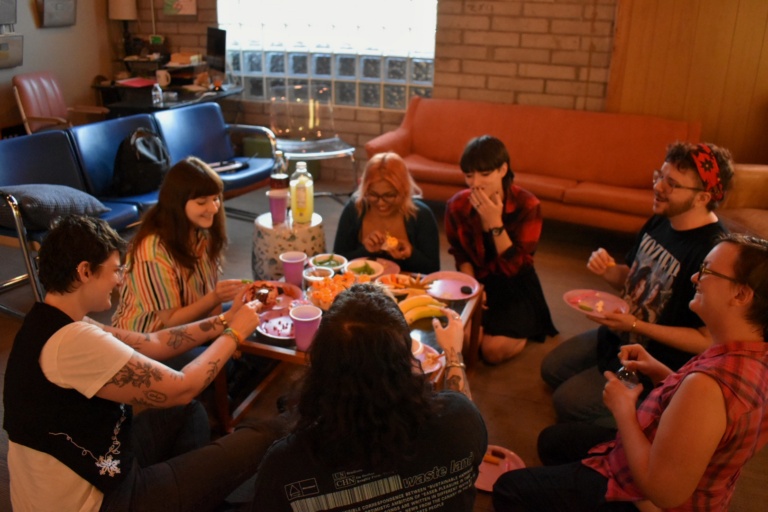
I was incredibly fortunate to have neighbors, friends and colleagues who all invited me to eat at their tables. I also turned to local businesses that were providing free meals for SNAP recipients, small businesses like my own job…which hosted a weekend-long food drive, and community fridges/pantries.
AzFBN: You were really involved in helping others get through the government shutdown as well. Can you talk about that?
Presley: I was in a somewhat unusual position of facing food insecurity while also volunteering my time and energy at work and in my community at food drives and distribution events. I was part of an effort by about five people to move and distribute over two tons of non-perishables!
I will never forget the woman who brought in bags and bags of baby food and formula and as she handed them to me her voice broke when she said, “Who takes food away from babies?”
Another day, I watched a mother cry as she picked up a baking kit someone donated that was complete with birthday candles and balloons. During those weeks we all held each other through every terrifying moment, and against all odds we fed and took care of each other. But the effects of food insecurity create lifelong trauma, and we cannot forget that…food is a human right.
I ended up doing five interviews with local news organizations, and the opportunity to speak for my own experiences as well as those of LGBTQ+ people and working artists on SNAP was a privilege I don’t take lightly. It is incredibly important that we continue talking about food insecurity in our city as a whole as well as how it disproportionally affects the LGBTQ+ community.
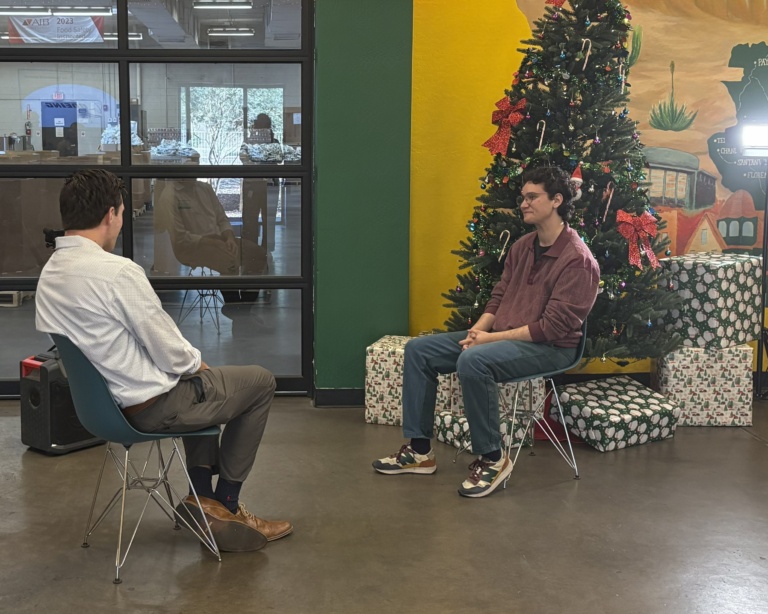
AzFBN: Aside from the scramble of the SNAP funding freeze, has anything changed for you since we last talked?
Presley: A lot has changed since November. I stress more, and I no longer enjoy grocery shopping, cooking, or sitting down to eat a meal. The effects of food insecurity are a devastating affront to all of your body’s systems, both physically and mentally.
DES is much harder to get ahold of, their call menus have changed and there is often not an option to be connected to a person or representative. The wait times have doubled, if not tripled [in my experience]. The mail communications are few and far between, and often arrive after changes have already gone into effect.
Last year I was awarded the highest EBT allotment for single individuals living alone, which was $298 monthly. After renewal I am now given $54 monthly. [My income is slightly higher than last year, but] I truly have no idea how I will make up the difference. I plan to supplement my grocery trips with trips to food banks and pantries, but it is an ever-present stressor.
AzFBN: What was different about the most recent certification process versus your initial application? You were so pleased with the process the first time.
Presley: The renewal process was much more lengthy and complex than originally getting approved. The requirements were recently updated, and now they needed a lot of additional information and documentation. And I’m not sure if it was because of the government shutdown, or the layoffs that happened within DES, but from February through the end of March, it was nearly impossible to get a human being on the phone.
I had to get three letters written: one from a neighbor or landlord certifying that I live alone; another from my parents to verify that they do occasionally help me with bills up to a certain amount when need arises; and lastly, they needed a letter from my part-time employer verifying that I do not work over a certain number of hours.
These letters were submitted in addition to the other documents I’m required to provide: the six months of self-employment income and expenses, Venmo, Cashapp, Zelle, Apple Cash, and bank statements for the last three months; paystubs from my part-time job for the last three months; receipts for my booth rent at my primary job; all bills I pay such as rent, utilities, water, sewage, trash, Wi-Fi and phone, etc… I’m sure I’m missing a few. It was a lot.
Another marked difference was the sheer length of both the renewal process as well as the phone interview. Previously, I was able to submit an application, all my documents, complete my phone interview, and I was awarded my SNAP benefits within that same month. This time, it took three months to finally receive benefits again…despite the fact that I was prompt and prepared for renewal.
My phone interview was more than four hours long on a weekday during business hours. I truly do not know how someone could take that call if they were not self-employed or working from home. While the DES agent was absolutely lovely and well informed, it was still exhausting and stressful to spend four hours verifying every document I was required to send in to them.
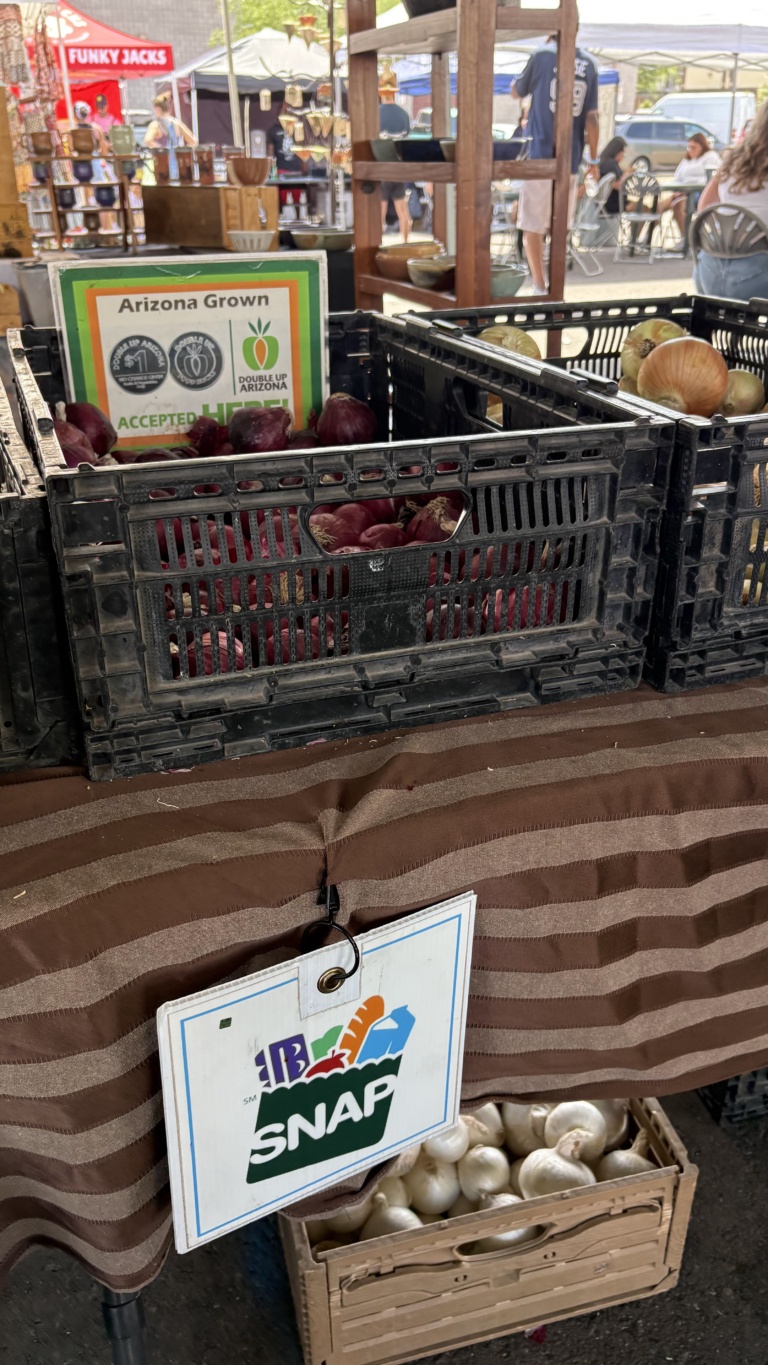
AzFBN: Three months and four hours…that’s quite a process. Let’s focus back on the importance of food and the dignity of choice, like we talked about before — What are a few of your favorite foods to buy with your SNAP benefits?
Presley: The things I use my SNAP funds on most often are milk and cereal, soup and bread, peanut butter and jelly for sandwiches, sometimes eggs and tortillas or bagels. For snacks I like to get cheese, strawberries or grapes, and crackers. When I’m able to go to the Downtown Phoenix Farmer’s Market, I use the Double Up program to stretch my SNAP funds further, and then I’m sometimes able to buy some fresh produce. On rare occasions that items at the grocery store are on sale and I have a few extra dollars, I’ll treat myself to a pack of M&M’s…
I wish there was more awareness and education surrounding what SNAP EBT is, who is eligible, and what it covers. [Through the government shutdown and leading up to it] I found myself pleading with people to recognize food as a human right, and I wondered how we had become so lost and callous.
AzFBN: We all need to talk about that more. So…when will you need to be recertified for SNAP again?
Presley: I was told at the end of my four-hour phone call that my next renewal would be three months from then, rather than six, because they were counting from the original date my benefits expired (which was in January)…even though I didn’t have benefits again until March.
I am overwhelmed and frustrated that I will only have three months of stability before doing this all over again. I don’t even know how to prepare for possibly facing another several months without benefits while I await my next renewal.
Presley’s experience with the renewal process directly reflects real policy changes that have taken effect since the federal budget bill. These policies were implemented so that DES could quickly comply with the new federal law, specifically the requirement for state agencies to reduce their payment error rate, which you can read more about here.
But at the same time, Presley’s experience tells us that people who need SNAP need the process to be easier. As he said, “My phone interview was more than four hours long on a weekday during business hours. I truly do not know how someone could take that call if they were not self-employed or working from home.”
If you need help, please click here.
If you can offer help, please click here.
If you want to share your story, anonymously or publicly, please click here.
 English
  Spanish